Nico
Nico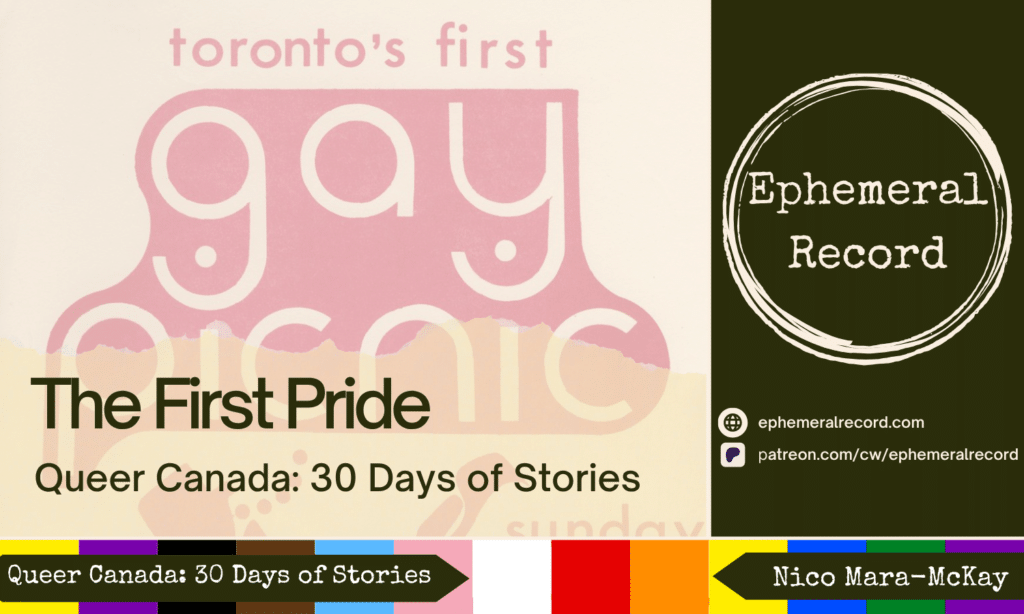
tl;dr: Two years after the partial decriminalization of homosexuality, hundreds of queer Canadians gathered at Hanlan’s Point. What began as a picnic became part of the foundation of Pride in Canada.
The partial decriminalization of homosexuality in 1969 sparked demands for greater change across the country. Decriminalization had not delivered equality: discrimination remained legal, police surveillance increased, and queer people continued to lose their jobs, housing, and families if they were outed. Yet, the amendment to the Criminal Code did create political space for a new generation of activists to organize more openly.
Building community
One of them was Jearld Moldenhauer. In October 1969, while working as a research assistant at the University of Toronto, Moldenhauer placed a classified ad in The Varsity, the university’s student newspaper, inviting anyone interested in establishing a student homophile organization to contact him. Half a dozen people responded, and shortly thereafter formed the University of Toronto Homophile Association (UTHA), the first openly gay student organization in Canada.
UTHA’s stated purpose was to educate the public, challenge discrimination, and bring about social and personal acceptance of homosexuality. However, after the organization received official recognition from the university, national media coverage prompted hostile responses. Shortly after Moldenhauer replied to a letter in The Globe and Mail, the university terminated his employment. With no legal protections against discrimination, the cost of speaking out publicly remained high.
UTHA’s community outreach helped inspire the formation of the Community Homophile Association of Toronto (CHAT) in December 1970. Six months later, in June 1970, younger activists split from CHAT because they felt it was too conservative, and founded Toronto Gay Action (TGA), a more explicitly political organization committed to direct action and social change.
The foundations of Pride
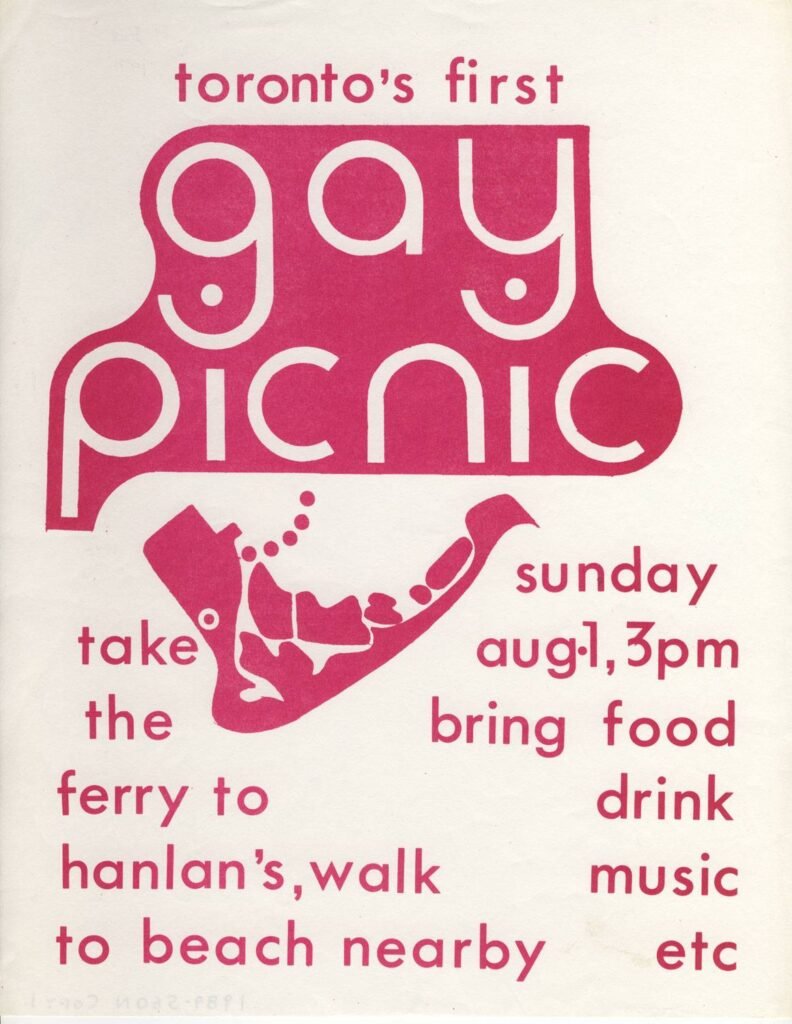
On 1 August 1971, TGA and CHAT organized a gathering at Hanlan’s Point on the Toronto Islands, which is held to be the first major gathering of queer people in Canada. Around 200-300 people attended the Gay Day Picnic, travelling from mainland Toronto, but also from communities across southern Ontario and the northeastern United States.
The gathering was a celebration of lesbian and gay identity, but it was also political. Participants shared food, met one another, and socialized. Organizers also distributed leaflets, discussed strategy, and finalized plans for a national demonstration in Ottawa later that month.
Earlier generations of queer Canadians were forced into secrecy by criminalization and social stigma. Yet, at Hanlan’s Point, hundreds gathered in public, during the day, and fostered community. The event was both a celebration of lesbian and gay identity, and also a reminder that Canadians deserved more than mere toleration.
From picnic to protest
On 28 August, some of those same activists would travel to Ottawa to participate in the We Demand demonstration, Canada’s first large-scale queer rights protest. The demands read by Charlie Hill would launch the next phase of the struggle for equality.
These momentum from these and other gatherings demonstrated that the queer community could take up public space. The following summer, organizers held a second Gay Picnic and Toronto’s first Pride Week. Despite Mayor William Dennison’s refusal to officially recognize the event, hundreds participated in a week of dances, picnics, workshops, and political discussions. Pride was built through community organizing and action, rather than permission.
Hanlan’s Point was recognized as a Historically Queer Space by the City of Toronto in 2023, and the gathering was commemorated on a Canada Post stamp in 2025. What began as a picnic became part of the foundation of Pride in Canada.
Further resources
Short videos
- “Places of Pride stamp issue: Hanlan’s Point Beach.” Canada Post, 2025.
- “University of Toronto Homophile Association (UTHA).” Year Zero One, 18 May 2014.
Bibliography
Anonymous. “A Gay Picnic.” Guerilla 2:8 (4 August 1971), 18.
The ArQuives. “Pride Before Pride.” The ArQuives, 25 June 2018.
Baetu, Teona. “U of T commemorates UTHA, Ontario [sic] first gay rights activist group.” The Varsity, 22 November 2011.
Canada Post. “2025 Places of Pride: Hanlan’s Point Beach – Official First Day Cover.” Canada Post, 2025.
Hardwin, D.F. “Letter to the editor.” The Globe and Mail, 7 January 1970.
Lawrence, Julia, Amanda Seraphina, and Anita Li. “Toronto’s Hanlan’s Point recognized as historically queer space.” CityNews, 23 June 2023.
Malik, Asuma. “Hanlan’s Point.” Asuma Malik, n.d.
McCaskill, Tom. “Pride: History + Protest.” In Joy. Sorrow. Anger. Love. Pride., 24-37.
Moldenhauer, Jearld. “Introduction for Toronto Gay Action, The Gay Alliance Toward Equality and CHAT.” Jearld Moldenhauer, n.d.
Moldenhauer, Jearld. “Reply to Mr. Hardwin’s Letter.” The Globe and Mail, 9 January 1970.
Robinson, Amanda. “Sexual Diversity Activism at the University of Toronto.” Ontario Heritage Trust, 2011, 2012.
Swanson, Raegan. “Pride Toronto 1970s to Today.” In Joy. Sorrow. Anger. Love. Pride., 38-101
Turner, Christopher. “A Brief History Of Toronto’s First Pride.” InMagazine, 28 June 2020.
Zorzi, P. “TGA (TORONTO GAY ACTION): Me And The Bars And Charlie And TGA.” On the Bookshelves, 1992, 2011.