tl;dr: The 1969 partial decriminalization of homosexuality was not liberation. It was a partial reform that exposed the limits of Canadian tolerance, but it did create a political opening for a new generation of activists to demand more.
The history of 2SLGBTQIA+ rights in Canada is often described in three broad phases: decriminalization, equality, and relationship recognition. This essay examines the first of these phases, and will treat the others later in the series.
Many Canadians are familiar with then-Justice Minister Pierre Trudeau’s famous remark that “there’s no place for the state in the bedrooms of the nation” and the subsequent amendment to the Criminal Code of Canada that partially decriminalized homosexuality. This story is often presented as a victory of enlightened politics, but that framing obscures the decades of activism, public pressure, and personal risk that made even this partial reform possible.
Criminalizing same-sex desire
From colonization, British anti-sodomy laws made sex between men illegal in Canada. The Consolidated Statutes of Canada were created in 1859 and were modelled after their British equivalent, which saw “buggery” an offense punishable by death. In 1892, it was reclassified as an “offence against morality,” and “gross indecency” was also added, which became illegal in Canada’s first Criminal Code. The law was intended to criminalize conduct beyond what was already covered under the anti-sodomy law, and was vague enough to encompass the criminalization of any expression of same-sex attraction between men, including simple touching like handholding, dancing, and kissing. In a 1953 amendment to the Criminal Code, this was extended to women.
Jim Egan and the demand for equality
Criminal charges and reports of court cases regularly made the pages of tabloid newspapers in the 1950s and 1960s. While convictions for buggery or gross indecency could result in life imprisonment, even suspicion could result in ostracization by family, friends, coworkers, and the community; as well as loss of housing, employment, and public exposure. There were no federal, provincial, or territorial protections for sexual orientation, gender identity, or gender expression. Fear of entrapment and arrest shaped everyday lives and relationships for queer people.
Starting in 1949, Jim Egan, often called Canada’s first gay activist, began writing letters to magazines and newspapers challenging the homophobic portrayals of homosexuals that dominated public discourse — most went unanswered. But by 1950, some of his letters began appearing in national publications, including the Globe and Mail. Between 1951 and 1954, he published a series of articles explaining homosexuality to predominantly heterosexual audiences. At a time when homosexuality was a criminal offence, his advocacy required admirable courage and conviction.
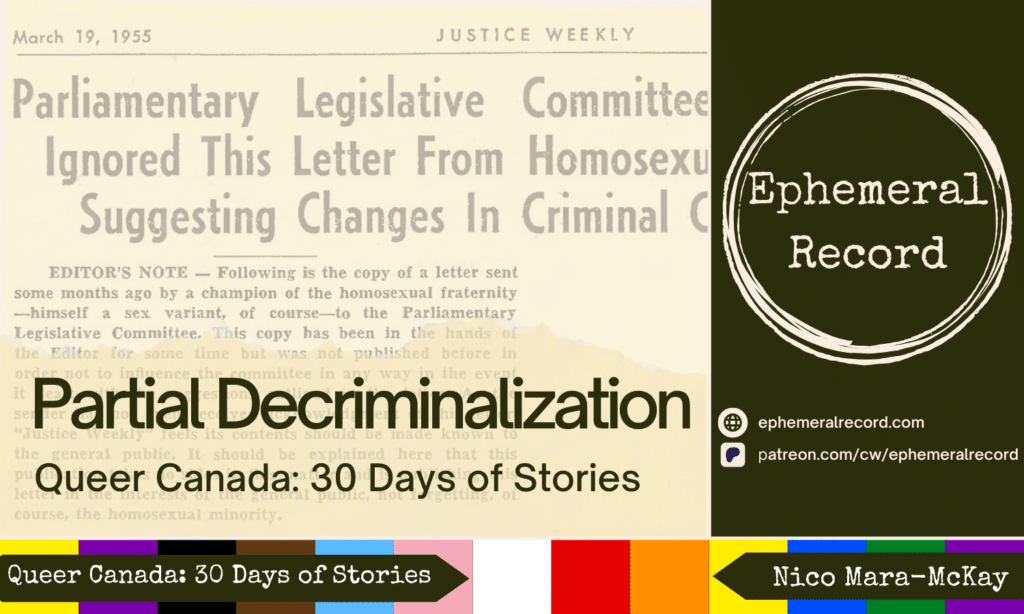
In 1954, Egan sent a letter to the House of Commons calling for the decriminalization of homosexuality and equal treatment under the law. In it, he specifically calls for amendments to the Criminal Code dealing with gross indecency, writing that it “directly affects the lives of thousands of Canadian citizens — not a mere handful of sex-degenerates, but thousands of essentially decent, respectable men from every social, economic, religious and intellectual level in the land.” Egan made appeals to science, statistics, and democracy; drew parallels with other persecuted minority groups; and asked for equal opportunity to live a “full life with dignity and freedom.” The letter went unanswered, but a few months later, it appeared in Justice Weekly, a Toronto tabloid.
Egan’s letters, articles, and appearance in the national media helped humanize homosexuality in public debate, but it was the case of Everett George Klippert whose case exposed the cruelty of Canada’s criminalization of homosexuality to the broader public.
Everett Klippert and public outcry
In 1965, Klippert, a mechanic living in the Northwest Territories, was arrested during an investigation into an arson case. Although he had no connection to the fire, he admitted that he had consensual sex with other men. For this, he was arrested and charged with gross indecency, for which he pleaded guilty. He had previously been jailed for homosexuality from 1960-1964, and a court-ordered psychiatrist determined him to be “incurably homosexual.” The presiding judge declared Klippert to be a “dangerous sexual offender” and sentenced him to indefinite imprisonment. Klipper’s appeal, first in the Court of Appeal for the Northwest Territories and then in the Supreme Court of Canada, were both rejected.
Klipper’s case attracted national attention and the Supreme Court’s decision generated intense media backlash. For many Canadians, Klippert’s case exposed the legal discrimination and human cost of criminalizing homosexuality: his relationships were consensual, he wasn’t accused of violence, yet the state argued he should be imprisoned indefinitely simply because he would continue being homosexual.
“No place for the state in the bedrooms of the nation”?
In November 1967, the day after Klipper’s final appeal was rejected, NDP leader Tommy Douglas raised the issue in the House of Commons and argued that homosexuality should not be treated as a criminal matter, stating that “homosexuality is a social and psychiatric problem rather than a criminal one.” Then-Justice Minister Pierre Trudeau (yes, Justin’s dad) agreed to set up a commission to study the issue.
Within six weeks, Trudeau presented an omnibus bill which, among other things, sought to partially decriminalize homosexual acts. During a CBC interview, he delivered one of the most famous statements in Canadian political history, stating,
It’s bringing the laws of the land up to contemporary society, I think. Take this thing on homosexuality. I think the view we take here is that there’s no place for the state in the bedrooms of the nation. I think what’s done in private between adults doesn’t concern the Criminal Code. When it becomes public, that’s a different matter.
The statement endured as a slogan for queer rights, but the legislation itself was hardly revolutionary. The amendment did not legalize homosexuality, establish equality under the law, or end state surveillance of queer people.
The limits of decriminalization
In 1969, the reforms to the Criminal Code received Royal Assent, and buggery and gross indecency laws were amended to make such acts legal under limited circumstances. The law applied only to consenting adults over the age of 21 and only in private settings, narrowly defined. If a third person was present, all parties could still be charged with gross indecency. Consensual queer sex continued to result in arrests and prosecutions.
Many members of the homophile movement (an early term used in queer community organizing) criticized the legislation for discriminating against homosexuals by requiring a considerably higher age of consent (21) than existed for heterosexual relationships (14 at the time, raised to 16 in 2008, with some exemptions).
Nor did the amendment end broader forms of discrimination. There were still no legal protections against discrimination in housing or employment. Indeed, in the wake of the amendment, police increased their use of indecency laws to target queer communities throughout the 1970s. Bathhouses, bars, parks, and other cruising areas remained subject to police surveillance and raids, and the threat of conviction was used to intimidate activists and disrupt community building. For most queer Canadians, daily life changed very little.
State surveillance also continued. The federal government continued its purge of 2SLGBTQIA+ employees from the civil service, military, and RCMP. Gross indecency remained in the Criminal Code until 1987, and the discriminatory age of consent for anal intercourse was not equalized until 2019 — a mere seven years ago.
On 20 July 1971, two years after homosexually had been partially decriminalized, Everett Klippert was finally released from prison. After his release, he moved to Edmonton where he worked as a truck driver. He married in the mid 1980s, and continually refused requests from activists in the growing gay rights movement to march in Pride or become a public figure. He died of kidney disease in 1996.
Opening the door
For all its limitations, the 1969 amendment did mark the first significant movement in criminal law to deregulate queer sex. Perhaps more importantly, it created a political opening for a new generation of activists to demand more than toleration: the struggle shifted from simply avoiding criminal prosecution to advocating for equal protection under the law.
Over the next few essays, we’ll look at the renewed activism that emerged and the activists who began building Canada’s Gay Liberation Movement in the 1970s.
Further resources
- The ArQuives’ education resources, particularly:
- “Egan’s letter to Parliamentary Legislative Committee.” Includes a copy of the original letter.
- “Parliamentary Legislative Committee Ignored this Letter from Homosexual Suggesting Changes in Criminal Code,” which includes an editor’s note prefacing Egan’s letter, which was also published in the tabloid Justice Weekly on 19 March 1955.
- “The Dangerous Sexual Offender Legislation: A Call for Abolition,” which includes excerpts from a publication from the National Gay Rights Coalition / Coalition Nationale pour les Droits des Homosexuels published c. 1976.
- The ArQuives’ digital exhibitions, particularly:
- LGBTQ+ Tabloid Newspaper, which includes sensational tabloid stories of queer and trans life in Toronto, as well as responses from those within and sympathetic to the queer community.
- Jim Egan: Canada’s First Public LGBTQ Activist, which includes examples of his early gay activism in the 1950s and 1960s.
Bibliography
Egan, Jim. Challenging the Conspiracy of Silence: My Life as a Canadian Gay Activist, compiled and edited by Donald W. McLeod. Canadian Gay and Lesbian Archives and Homewood Books, 1998. (Available as a free PDF from TSpace.)
Government of Canada. “Criminal Code (R.S.C., 1985, c. C-46).” Last amended 26 March 2026.
Government of Canada. “Section 159 of the Criminal Code.” November 2016, last modified 15 November 2016.
Kinsman, Gary. The Regulation of Desire: Queer Histories, Queer Struggles, revised third edition. Montréal: Concordia University Press, 2024.
Knegt, Peter. About Canada: Queer Rights. Fernwood Publishing, 2011.
Levy, Ron. “The 1969 Amendment and the (De)criminalization of Homosexuality.” The Canadian Encyclopedia, 26 November 2019.
[Mooney], Sarah. “Canadian soldiers in wartime.” Canadian Museum for Human rights, 8 November 2024.
Note: This essay contains affiliate links. Ideally, if you’re going to purchase a book, please do some from a local independent bookstore. But if you’re going to buy from Amazon anyway, it wouldn’t hurt to click through one of the affiliate links, which will send a few pennies my way at no cost to you. Money earned through Patreon and affiliate links helps support my work.