Nico

tl;dr: Jacob’s Transition Goals is a children’s picture book about a trans boy who loves football and transfers to a boy’s team after coming out. When some of his new teammates bully him, Jacob’s coach works with an LGBTQ+ youth worker to address the transphobia and help create a more supportive environment.
Jacob’s Transition Goals, written by Arthur Weber, illustrated by Ang Hui Qing (Jessica Kingsley Publishers, 2026)
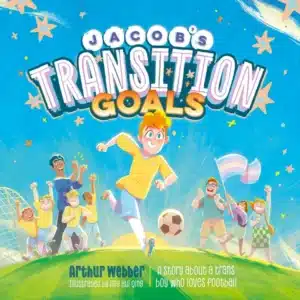
Jacob loves football. He supports Paston City with family, and he used to play with a girl’s team. But now that he’s come out as transgender, he’s about to join a boy’s football team. His parents are supportive, and the book explains what it means to be transgender in age-appropriate, easy-to-understand terms. This includes aspects of social transition, such as using a new name and pronouns, getting a new haircut, and choosing clothing that matches his gender identity.
When his parents explain to his new coach that Jacob is transgender, Coach Sanchez is warm and welcoming, telling him that “All boys are welcome” on the team.
Nevertheless, even with that support, Jacob was nervous about joining the team. Some of the boys at school have been mean to him, and he worries about how his teammates will treat him. But Jacob is also proud to be transgender and he’s confident that, as a boy, he belongs on the boy’s team.
Unfortunately, Jacob’s concerns prove justified. Some of the boys on his team refuse to play with him and taunt him with misogynist and transandrophobic slurs. The book doesn’t minimize the impact of their behaviour or suggest that acceptance will happen automatically. Instead, it shows bullying for what it is: hurtful and unacceptable behaviour that adults have a responsibility to address.
Coach Sanchez is angry when he sees what is happening. He calls out the boys’ transphobia and makes it clear that bullying Jacob isn’t acceptable, while also giving the team an opportunity to work together. The boys apologize to Jacob, reluctantly, but they don’t talk to him at school.
Understandably, Jacob is nervous about the next game, but unbeknownst to him, Coach Sanchez has organized a meeting for the other players and their parents with an LGBTQ+ youth worker, who explains what it means to be transgender and answers their questions. This gives both the children and adults an opportunity to learn before another incident occurs, rather than leaving Jacob vulnerable to further bullying.
The next game, the difference is noticeable. The other boys pass Jacob the ball, give him the opportunity to take a free kick, and hug him and celebrate with him when he scores a goal.

One of the strengths of Jacob’s Transition Goals is that it doesn’t shy away from the fact that trans children can encounter harmful treatment from their peers. At the same time, it doesn’t leave the reader with the impression that bullying is something trans children should be expected to endure. The story identifies a problem, shows the support networks around Jacob, and demonstrates concrete ways that adults can work to address it. An adult reading this book with a child might use it as an opportunity to talk about what another child could do to intervene: What could they say or do to let Jacob know that he is welcome, supported, and not alone?
The book is particularly useful in showing that there is more to supporting a trans child than simply affirming their identity in the abstract. Coach Sanchez’s response also provides an opportunity to consider what could have been done differently. For example, an orientation session with the players and their parents before Jacob’s first game could have given everyone an opportunity to ask questions and understand how to support their new teammate before problems arose. The story therefore offers adults not only a model for responding to transphobia, but also serves as a prompt to think about how they can be proactive rather than reactive.
Following the story is a short guide for adults, including a glossary of terminology and an FAQ. This makes the book particularly useful for parents, caregivers, educators, and coaches who may be encountering some of these concepts for the first time.
The book takes a straightforward approach to the question of trans children in sport. It doesn’t challenge the existence of sex-segregated sport or explore the broader debates surrounding them. Instead, its concerns are narrower: if a trans boy is playing football, he should be able to play on the boys’ team. For a picture book aimed at children, that narrow focus makes sense; a more expansive discussion of gender, sport, or the complexities of sex segregation can be approached elsewhere.
Ang Hui Qing’s illustrations complement the story well. The dynamic football scenes give the book a strong sense of movement, while the expressive faces help communicate characters’ emotions.
Jacob’s Transition Goals is a timely addition to conversations about trans children and sports. More importantly, it gives young readers a story in which being trans isn’t presented as a problem. The real problem is other people’s prejudices, and the book shows the adults around Jacob taking responsibility for addressing it productively.
Note: This review contains affiliate links, which help me survive under capitalism, cost you nothing, and did not influence the content of the review.